












Cracking the banking Barrier: How Catalytic Capital scaled Green Lending in India

Overview
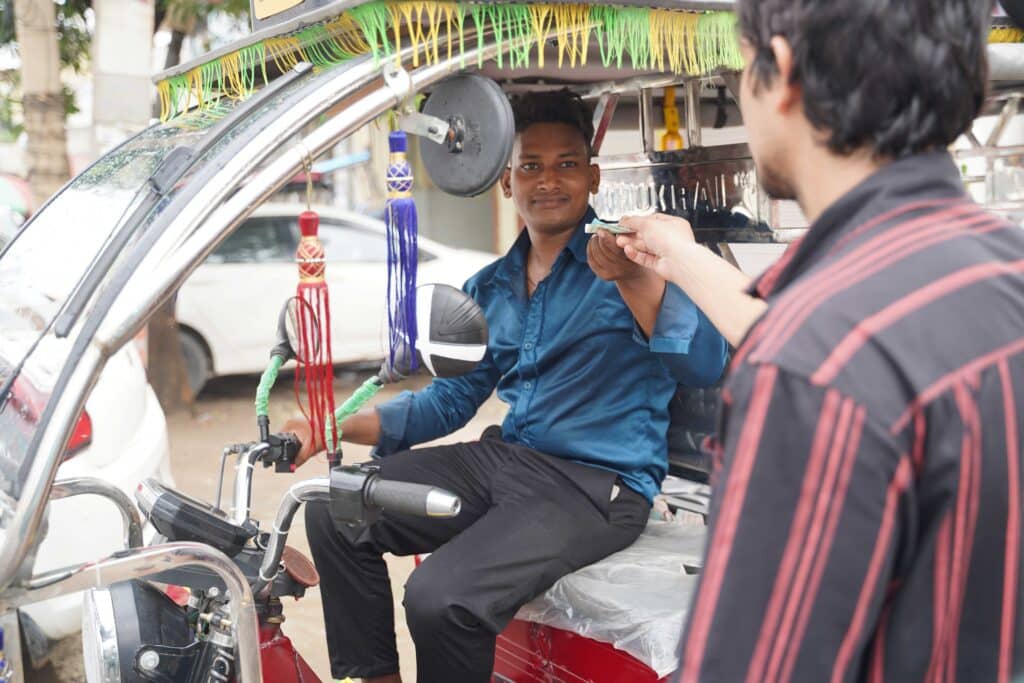
Mufin Green Finance Limited (Mufin) is India’s first publicly listed non-banking financial company (NBFC) dedicated exclusively to green financing. Founded in 2016, Mufin was established to address a structural gap in India’s financial system: the exclusion of low-income, informal workers from access to capital, despite clear evidence that clean energy assets – particularly electric vehicles – can generate stable and sufficient incomes. Mufin serves nano-entrepreneurs such as erickshaw drivers, delivery riders, and small transport operators, 84% of whom are first-time borrowers, by financing electric two-, three-, and four-wheelers, charging infrastructure, swappable batteries, and, more recently, solar energy solutions. By assessing creditworthiness using cash flows and asset economics rather than salary slips or traditional collateral, Mufin has demonstrated that climate-aligned lending and financial inclusion can be mutually reinforcing.
What distinguishes Mufin’s evolution is not only its growth, but the way that growth was enabled through a carefully sequenced use of catalytic capital to overcome systemic risk barriers. Early validation from impact investors and global green bond markets established institutional credibility, but mainstream commercial banks remained reluctant to lend at scale to a portfolio dominated by informal, first-time credit users. The turning point came in 2023, when a purpose-built de-risking mechanism, co-designed with Shell Foundation, absorbed initial credit risk and fundamentally shifted lender perceptions. This intervention unlocked large-scale domestic banking capital, catalysed rapid balance sheet growth, and repositioned Mufin from a specialist green lender to a nationally significant financial intermediary.
By 2026, Mufin had expanded across 26 states with cumulative disbursements exceeding $180 million and assets under management above $108 million. It had mobilised capital from India’s largest public banks, global development finance institutions, and public market investors, while remaining anchored to its original mission: enabling access to clean, income-generating assets for populations historically excluded from formal finance. Mufin’s trajectory offers a concrete demonstration of how targeted de-risking and catalytic capital can unlock markets, shift financial system norms, and accelerate the energy transition at scale.
Phase 1
Validation (2022–2023): Proving the Model
From its early operations, Mufin demonstrated that lowincome EV operators were creditworthy when assessed using alternative data – vehicle economics, cash flows, and usage patterns rather than salary slips or traditional collateral. What remained unproven was whether this model could scale institutionally within India’s regulated financial system.

To address this, Mufin executed a strategic acquisition in 2022, gaining control of an already listed and Reserve Bank of India (RBI)regulated NBFC. This move compressed years of regulatory and capitalmarket preparation into months, creating an investable platform purposebuilt for green lending.
That foundation enabled Mufin to raise $5.4 million in Series A equity from the Incofin India Progress Fund, followed by a $7 million internationally certified green bond arranged by Symbiotics and listed on the Luxembourg Green Exchange. Together, these transactions delivered two critical outcomes: domestic institutional credibility and international green certification.
By early 2023, Mufin had proven three things simultaneously: its borrowers repaid, its balance sheet was investable, and its assets met international ESG standards. AUM grew from $19 million to $30 million, but the ceiling on growth was becoming clear. As of 2023, Mufin had already reduced over 100,000 tonnes of carbon emissions through its financed fleet. It had also established the three layers of trust needed for the next phase of growth: a regulated platform, an impact equity anchor, and international green certification. affordable, large scale debt from mainstream Indian banks.
Phase 2
Scale (2023–2024): Unlocking Commercial Capital for scale
Despite strong performance data, Indian banks remained cautious. Lending to an NBFC whose entire portfolio consisted of firsttime credit EV operators still failed conventional risk tests. What banks needed was not more proof of concept, but explicit risk absorption.

To address this concern, Shell Foundation, in July 2023, committed $1 million to Mufin to create, alongside Mufin’s own capital, a $2 million First Loan Default Guarantee (FLDG). This facility sat ahead of Mufin’s loan portfolio, absorbing initial losses before senior lenders were exposed. The instrument fundamentally altered the riskreturn profile of lending to Mufin.
This was not a subsidy to borrowers, nor balance sheet support to the company. It was a precision derisking mechanism designed to crowd in commercial capital at scale. Over a fiveyear horizon, the FLDG was structured to mobilise $40–60 million in bank lending, recycled across multiple lending cycles and financing tens of thousands of electric vehicles for lowincome clients.
The market response was immediate. With the FLDG in place, Mufin raised $63 million in debt from over thirty lenders in 2023 alone. This included the State Bank of India and Indian Renewable Energy Development Agency (IREDA) institutions whose participation signalled, unmistakably, that EV lending to firsttime credit users had entered the financial mainstream. ICICI Bank, Kotak Mahindra, Northern Arc, and AU Small Finance Bank followed.
By December 2023, Mufin’s AUM had doubled to $60 million, operations had scaled nationally, and the longstanding barrier between specialist green lenders and India’s core banking system had been definitively breached. At the centre of that shift was Shell Foundation’s derisking capital being the causal bridge between proof and scale. The capital unlocked by Shell Foundation’s contribution had the immediate impact of allowing Mufin to reach over 22,000 drivers and reduce over 23,900 tonnes of carbon dioxide emissions by the end of 2023.
Phase 3
International Endorsement (2024–2026): From National to Global Credibility
With domestic banks now fully engaged, Mufin turned to longtenor international capital to match the life of EV and cleanenergy assets. This phase converted the credibility earned earlier into global DFI participation.
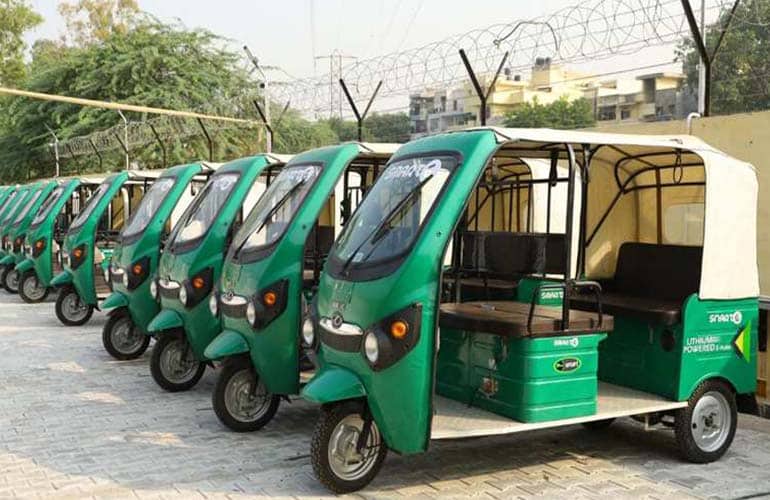
In December 2024, Mufin secured an $18 million tenyear loan from the U.S. International Development Finance Corporation (DFC). This was followed by commitments from Developing World Markets and Finnfund. These institutions were not validating a concept; they were backing a proven, scaled intermediary capable of anchoring India’s EV transition over the long term.
Importantly, these DFIs cited the same features mainstream banks had initially resisted – firsttime borrowers and informal incomes as primary indicators of mission alignment, not risk. The signalling effect compounded: each international commitment reduced perceived risk for the next.
By the end of 2025, Mufin’s activities have seen it reduce over 160,000 tonnes of carbon dioxide emissions and reach over 63,000 drivers of electric vehicles
Phase 4
Institutionalisation (2025–2026): Building a Durable Listed NBFC
By Phase 4, the focus shifted from ‘access to capital’ to ‘durability’. Mufin diversified its funding base through repeatable nonconvertible debenture (NCD) issuances and completed a $39 million preferential equity allotment with domestic institutional and familyoffice investors.
Simultaneously, it expanded beyond EVs into rooftop solar, charging infrastructure, insurance premium financing, and salarylinked credit – extending its inclusion model across energy and social resilience needs while maintaining underwriting discipline.
By early 2026, Mufin had become what few greenfinance institutions in emerging markets achieve: a publicly listed, multiproduct NBFC with a diversified capital stack and sustained commercial confidence.
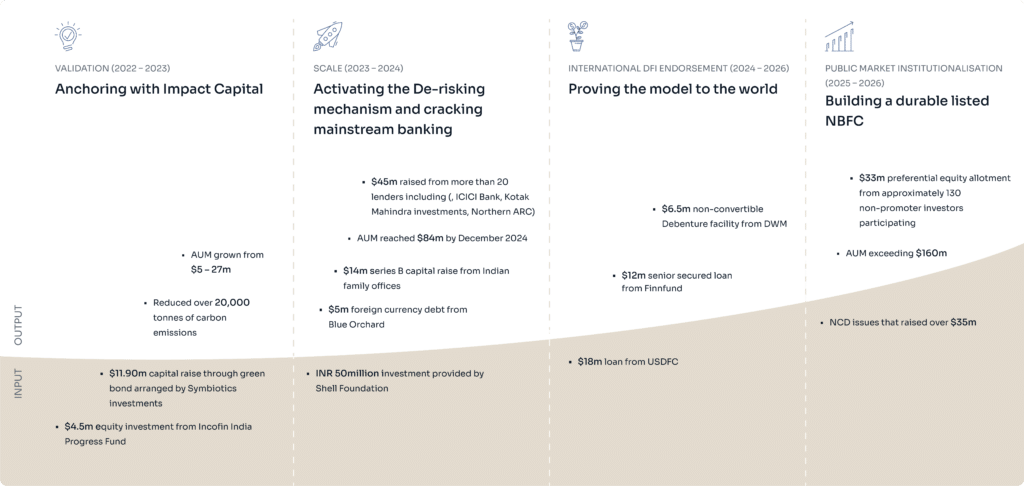
| S/N | Phase | Input | Output |
| 1 | Validation (2022 – 2023): Anchoring with Impact Capital | – $5.4m equity investment from Incofin India Progress Fund – $7m capital raise through green bond arranged by Symbiotics investments | – AUM grown from $19 – 30m – Reduced over 100000 tonnes of carbon emissions |
| 2 | Scale (2023 – 2024): Activating the De-risking mechanism and cracking mainstream banking | – $1m investment provided by Shell Foundation to create a $2m joint First Loan Default Guarantee | – $63m raised from more than 30 lenders including (SBI, IREDA, ICICI Bank, Kotak Mahindra investments, Northern ARC) – AUM reached $60m – $17m series B capital raise from Indian family offices – $5m foreign currency debt from Blue Orchard – Reached over 22,000 drivers and reduced over 23,900 tonnes of carbon emissions |
| 3 | International DFI Endorsement (2024 – 2026): Proving the model to the world | – $18m loan from USDFC | – $6.5m Non-convertible Debenture facility from DWM – $12m senior secured loan from Finnfund – Reached a total of over 63,900 drivers and reduced over 160,000 tonnes of carbon emissions by the end of 2025 |
| 4 | Public Market Institutionalisation (2025 – 2026): Building a durable listed NBFC | – NCD issues that raised over $35m | – $39m preferential equity allotment from approximately 130 non-promoter investors participating – AUM exceeding $108m |